AI Is About to Make Digital Banking Competition Faster

When every bank can analyse competitors, identify product gaps and track market moves faster, where does competitive advantage move next?

Digital banking competition is about to get faster.
Not simply because AI will help banks automate processes, write code or improve customer service.
But because it is becoming much easier for banks to understand what their competitors are doing — and what they should do about it.
Consider the questions facing a digital banking leadership team today.
How does our SME proposition compare with Qonto, Tide, Revolut Business or Allica?
Where are competitors expanding their propositions?
Which capabilities are we missing?
Which players are strengthening their position?
And which emerging competitor should we be watching next?
Answering those questions properly has traditionally required time: monitoring competitors, searching multiple sources, comparing propositions, collecting financial information and turning it into something management can use.
AI is beginning to compress that process dramatically.
The launch of ChatGPT for Financial Services is one of the clearest signals yet. OpenAI is bringing advanced AI together with financial data, company research, analysis and institutional information — making sophisticated financial intelligence faster and increasingly accessible.
For digital banking, the implication goes beyond productivity.
Competitors are becoming easier to understand.
A strategy team can increasingly analyse another bank, compare propositions, identify product gaps, examine financial performance and translate those findings into management insight in hours rather than days.
And the same capability will increasingly be available across the market.
That leads to the question at the centre of this Strategic Note:
If every bank can understand its competitors faster, does competitive advantage become harder to sustain?
AI is already changing more than how banks operate. It is changing where financial decisions begin, how customers navigate them and, increasingly, how institutions understand the market around them.

Digital banking advantages may become easier to identify — and copy
Digital banking has always been highly visible.
A competitor launches a new savings product.
Another adds invoicing to its SME proposition.
A digital bank introduces investment products.
A specialist lender moves into current accounts.
A challenger enters another European market.
Much of this can be observed from the outside.
What has traditionally been difficult is connecting all those individual developments into a clear picture of where a competitor is going.
AI makes that easier.
It can monitor large volumes of information, connect developments that might otherwise be missed and dramatically reduce the time required to analyse a competitor.
That matters because competitive advantage in digital banking is rarely built from a single feature.
It comes from combinations of capabilities, economics, distribution, customer engagement and execution.
If AI makes those combinations easier to understand, successful strategies may also become easier for competitors to recognise.
The result could be a market in which competitive advantages are identified—and challenged—faster.
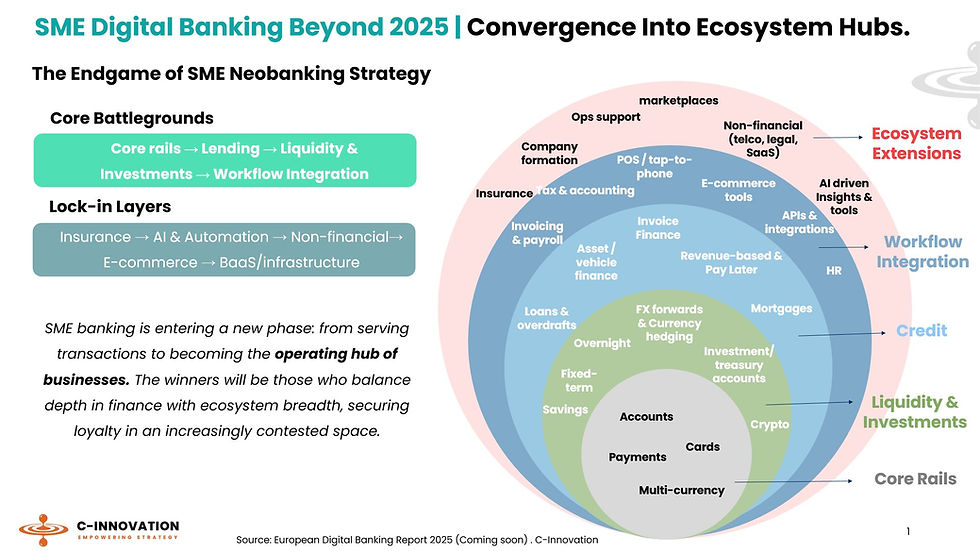
Consider what this means in European SME banking
The current SME banking market provides a useful example.
Qonto has been building a broad financial management proposition around the business account.
Tide has expanded beyond banking into a wider ecosystem of services for small businesses.
Allica has followed a different route, combining digital banking with deeper lending and relationship-led capabilities for established SMEs.
Revolut Business continues to build from payments and international banking into a broader business finance proposition.
These are not simply four lists of product features.
They represent different strategic models.
AI can increasingly identify what each institution offers.
But the important question for another bank is not: "Does Qonto offer invoicing?"
It is: What is Qonto trying to become—and what does that mean for our own competitive position?
That distinction becomes fundamental in an AI-rich market. As strategic models become easier to understand, competitors may also become faster at responding to them.

More information does not automatically create better decisions
This is where the opportunity and the risk begin to separate.
AI can tell a bank more about its competitors.
But every competitor can use the same technology.
Information that was once difficult to collect becomes easier for everyone to access.
So simply knowing more becomes less of an advantage.
The value moves toward understanding what the information means.
Which developments matter?
Which are simply feature additions?
Which competitors are genuinely strengthening?
Where is the market converging?
Where are new competitive models emerging?
And how quickly should your own institution respond?
Those questions require more than information.
They require context, consistent comparison and an understanding of change over time.
The competitive advantage moves
This leads to an important conclusion for banks.
AI itself is unlikely to remain a sustainable competitive advantage.
A large incumbent will have access to powerful AI.
So will a digital challenger.
So will an SME specialist.
So will the next FinTech entering the market.
The differentiator therefore begins to move toward what surrounds the technology.
Your proprietary customer data.
Your understanding of customer economics.
Your knowledge of how competitors are evolving.
Your ability to distinguish an important market signal from noise.
And, critically, your ability to act faster on what you learn.
This could favour very different types of institutions.
Large banks have enormous proprietary datasets.
Digital challengers can often move faster.
Specialists may understand particular customer segments more deeply.
Competitive advantage may increasingly favour institutions that combine these strengths most effectively with AI.
Digital banking could become an even faster competitive market
Technology has already reduced many of the barriers that once protected banking incumbents.
Cloud infrastructure made technology cheaper to build.
APIs made financial services easier to connect.
Digital distribution made customers easier to reach.
AI may now make competitors easier to understand.
That could accelerate competition again.
Successful products can be identified faster.
Capability gaps become more visible.
Emerging competitors become easier to detect.
Strategic moves can be analysed more quickly.
And best practices can spread across markets faster than before.
For digital banking leaders, that means competitor monitoring cannot simply answer:
What are they doing?
Increasingly, it needs to answer:
Why are they doing it?
Is it working?
How is their position changing?
And what does it mean for us?
When everyone can see more, understanding matters more
The arrival of increasingly capable financial AI does not reduce the importance of competitive intelligence.
It changes it.
Finding information becomes easier.
Comparing competitors becomes faster.
Producing analysis becomes cheaper.
But understanding which changes matter and what they mean for your competitive position remains difficult.
And as more banks gain access to similar AI capabilities, that distinction becomes increasingly important.
The next competitive advantage in digital banking may therefore not come from having access to more information.
Everyone will have more information.
It will come from combining AI with better proprietary data, stronger market context, consistent competitive intelligence and faster execution.
Because when every bank can see what competitors are doing, the real advantage is understanding sooner what it means.
C-Innovation Perspective | Competitive intelligence becomes a speed advantage
We believe AI will make digital banking competition faster, more transparent and increasingly difficult to defend through product features alone.
Over the next few years, banks will become considerably better at identifying what competitors are doing. New propositions will be analysed faster, capability gaps will become more visible and successful ideas will travel more quickly between institutions and markets.
That does not mean every bank will converge on the same model.
Quite the opposite.
As access to information and analytical capabilities becomes more equal, the differences between institutions may increasingly come down to what they know that others do not, how well they interpret what is changing, and how quickly they can respond.
We therefore expect competitive intelligence to move away from periodic competitor reviews toward something more continuous: tracking not simply launches and features, but changes in proposition, customer value, financial strength, growth and strategic direction over time.
For digital banking leaders, the question will increasingly shift from:
What are our competitors doing?
to:
Which competitive positions are strengthening, why are they strengthening, and what should we do about it?
This is also why we believe proprietary and structured intelligence will become more valuable as AI becomes more capable. AI can dramatically improve the speed of analysis, but its strategic value will depend on the quality, consistency and history of the intelligence around it.
The next phase of digital banking competition will therefore not be won simply by the institutions with the most AI.
It will be won by those that turn better intelligence into better decisions — faster.


Comments