Digital Banking 2026 Trends: The Structural Shift Reshaping Strategy and Execution

Updated: Apr 27
Digital banking is not changing direction — it is changing where control sits.
A concise Executive Brief is available for a quick synthesis of these shifts.
The Shift No One Sees — But Everyone Feels
Until recently, the industry rewarded:
Scale over structure
Feature expansion over execution depth
Market entry over operational control
Today, leadership is being redefined by something far more structural:
Who controls how financial systems execute, monetise, and scale
As highlighted in our Q1 2026 analysis, the industry is transitioning:
From growth → earnings
From interfaces → execution systems
From products → control layers
In this strategic note, we unpack what is driving this shift — and what it means for how products are built, scaled, and monetised.
Specifically, we cover:
The five structural forces reshaping digital banking in Q1 2026
How AI, capital, infrastructure, and distribution are redefining product strategy
Why execution and monetisation — not growth — are now the core competitive levers
And this is where the real shift lies:
Digital banking is no longer about building better apps. It is about controlling how financial decisions are made and executed.
The Core Shift: Product Has Become Strategy

What changed in Q1 2026 is not visible on the surface.
It sits underneath the product.
AI is now executing decisions in real time
Capital determines which products can exist
Infrastructure defines execution quality
Distribution is embedded into workflows
Product is no longer a layer. It is the system where strategy is executed.
The New Competitive Battlefield

The competitive model has fundamentally shifted — but not in a way that is immediately visible.
What once looked like a race for scale is now a question of execution quality and structural control.
Growth, features, and distribution still matter — but they no longer define leadership on their own.
They are being reshaped by deeper forces:
AI is determining how decisions are made
Infrastructure is defining how transactions are executed
Capital is setting the boundaries of product expansion
Distribution is moving into the environments where activity already happens
This is already visible in how players like Revolut are evolving — not just expanding into new markets, but building control across licensing, infrastructure, and product execution layers.
The implication is clear:
Winning players are no longer those who grow fastest. They are those who control how the system operates end-to-end.
The 5 Forces Reshaping Digital Banking (Q1 2026)

1. AI Becomes the Decision Layer

AI is no longer supporting products.
It is embedding directly into product logic — from decisioning to execution.
What is changing is not just automation — it is where decisions are made.
Payments are no longer processed → they are optimised and executed in real time
Credit is no longer applied for → it is decided within the transaction flow
Collections are no longer reactive → they are driven by AI-led recovery systems
The shift is structural:
Products are no longer collections of features. They are decision systems that continuously evaluate, decide, and execute.
This is already visible across the market:
Klarna / checkout credit models → credit decisions happening instantly at the point of purchase, based on real-time user and transaction data
Visa / network-level AI decisioning → fraud, routing, and approval decisions increasingly happening before the transaction reaches the bank
The implication:
Control is no longer at the interface. It sits in the decision layer that governs how every transaction is executed.
2. Product Is Becoming Balance-Sheet Dependent

Product expansion is no longer driven by features. It is constrained—and enabled—by balance sheet control.
What determines how far a product can go is no longer roadmap ambition, but:
Funding capacity
Risk-bearing capability
Licensing depth
The shift is structural:
Without balance sheet control, product depth stalls. With it, products expand into lending, savings, and capital-intensive services.
This divergence is already visible in the market:
Revolut is accelerating expansion by building control across licences and funding — unlocking new lending products and entering markets like Mexico with full execution capability
Monzo, by contrast, is showing increased capital discipline — including withdrawing from the US market — refocusing on where balance sheet strength and lending performance can be sustained
The implication:
Product is no longer designed.
It is deployed through capital.
And increasingly: The next generation of products will be shaped by balance sheet capacity — not feature design.
3. Execution Is Moving into Infrastructure
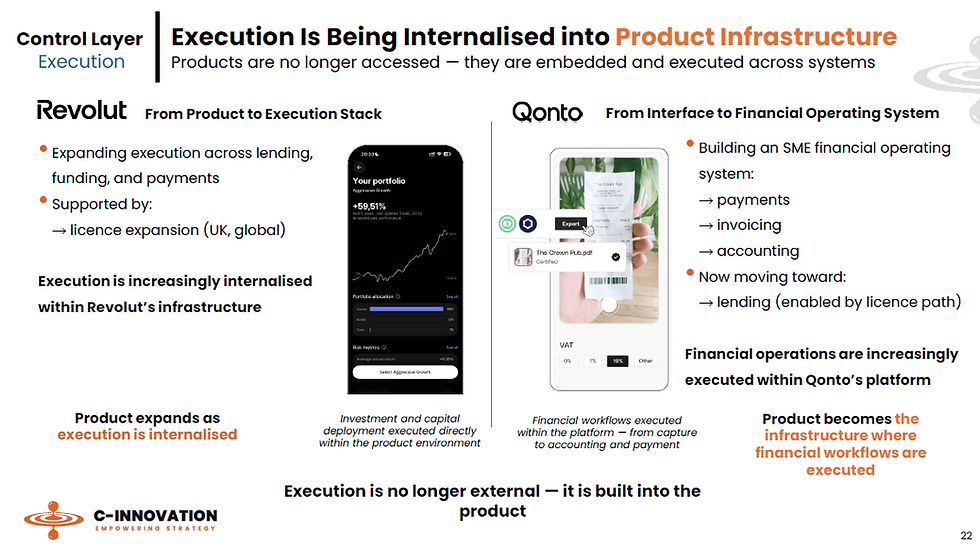
Financial services are no longer something users access.
They are becoming something that is embedded and executed across systems.
What is changing is not the interface — it is where execution happens.
Payments are executed within merchant and network infrastructure
Lending is triggered inside workflows and operational systems
Financial operations are increasingly handled within platforms, not apps
The shift is structural:
Execution is moving from external providers into owned product infrastructure.
This is already visible across leading players:
Revolut is internalising execution across payments, lending, and capital deployment — building an integrated execution stack supported by its expanding licensing footprint
Qonto is embedding financial services directly into SME workflows — turning its platform into a financial operating system where payments, invoicing, and accounting are executed in one place
The implication:
Control is no longer defined by the interface.
It is defined by who owns and operates the execution layer.
And increasingly: Execution is no longer external — it is built into the product.
4. Distribution Is Moving into Embedded Environments

Distribution is no longer about acquiring users.
It is about embedding financial services into the environments where activity and decisions already happen.
What is changing is not how users discover products —it is where financial services are executed.
Finance is moving into AI interfaces, where decisions are made in real time
Payments and financial operations are embedded into business workflows
Products are increasingly integrated into operating systems — not accessed via apps
The shift is structural:
Distribution is no longer a channel.
It is a function of integration into activity.
This is already visible in the market:
Brex is embedding financial services directly into AI environments — enabling finance to be executed inside decision layers, not separate tools
Ramp is integrating payments into business workflows — where financial activity happens automatically within operational systems
The implication:
Growth is no longer driven by traffic or acquisition.
It is driven by how deeply products are embedded into workflows, platforms, and decision environments.
And increasingly: Distribution is defined by where the product is used — not where it is accessed.
5. Monetisation Is Replacing Growth

The industry is no longer optimising for growth.
It is being restructured around earnings quality and revenue depth.
What matters is no longer how many users a product acquires —but how effectively it monetises engagement over time.
Revenue is embedded directly into product usage
Lending, payments, and subscriptions are designed as core monetisation engines
Product decisions are increasingly driven by margin, capital efficiency, and risk-adjusted returns
The shift is structural:
Monetisation is no longer a layer added on top of the product. It is built into how the product operates.
This is already visible in the market:
Zopa is expanding lending and savings as core revenue engines — structuring its product around profitability, not just growth
Chime is embedding monetisation into usage — where revenue is generated through engagement, not acquisition
👉 The implication:
Revenue no longer scales with users.
It scales with how deeply products are integrated into financial behaviour.

This shift is now creating a clear structural separation across the market.
Players are no longer competing on growth alone —
they are diverging based on revenue architecture and earnings durability.
Transaction-led models remain constrained in monetisation depth
Platform models show emerging revenue potential
Credit and asset-backed models generate higher ARPC and more durable earnings
And this is where leadership is now defined:
Not by scale — but by the ability to convert activity into revenue efficiently and consistently.
For a deeper breakdown of how these models perform under pressure — and which ones sustain earnings over time — see our Earnings Architecture 2026 deep-dive.
The strongest players are not those with the most users.
👉 They are those with:
Higher revenue per customer
Stronger lending economics
Embedded monetisation flows
What This Means Strategically
The New Definition of Product
Product is no longer:
UX
Features
Interface
👉 Product is now:
Decision system (AI)
Capital deployment engine
Execution infrastructure
Distribution layer
The New Definition of Scale
Scale is no longer:
Users
Markets
Features
👉 Scale is now:
Licensing depth
Balance sheet control
Execution quality
Monetisation durability
The Real Divide in 2026

The market is no longer separating by size or growth.
It is separating by structural control and earnings durability.
Two distinct models are emerging:
1. Expansion-Led Platforms (Reversible Scale)
Built on growth momentum and distribution reach
Monetisation remains shallow or inconsistent
Dependence on partners limits control over execution and capital
Scale is visible — but structurally fragile.
2. Structurally Embedded Operators
Built on earnings generation and capital deployment
Enabled by licensing depth and balance sheet control
Integrated across infrastructure, distribution, and execution layers
Scale is not just achieved — it is sustained and controlled.
What This Means
Leadership in digital banking is no longer defined by how fast you grow.
It is defined by: How deeply you are embedded into the financial system — and how effectively you convert that position into durable earnings.
What Leaders Are Getting Wrong
Across Q1 signals, a consistent pattern is emerging — not of execution gaps, but of misaligned strategic assumptions.
Three structural blind spots stand out:
1. Treating AI as a feature — not a control layer
AI is still being deployed at the interface level, rather than embedded into decisioning and execution systems where real advantage is created.
2. Scaling products without balance-sheet depth
Growth is being pursued without the capital, risk, and licensing foundations required to sustain product expansion and monetisation.
3. Prioritising growth without a monetisation architecture
User acquisition continues to be optimised, while revenue generation remains fragmented or delayed — limiting long-term earnings power.
The implication is critical:
These are no longer tactical missteps that can be corrected over time.
They reflect structural limitations in how the business is built.
And in 2026: Structure — not speed — determines who can sustain scale.
Forward Look: Where This Is Going Next
The next phase of digital banking is no longer emerging — it is already taking shape.
What we are seeing in Q1 signals is the early formation of a new operating model:
AI agents moving from decision support to full workflow execution
Licensing becoming a prerequisite for meaningful expansion — not a strategic option
Execution infrastructure being internalised as a core capability — not outsourced
Distribution concentrating within a small number of platforms, ecosystems, and AI environments
But the most important shift is this:
Financial services are moving from being user-initiated to system-executed.
Decisions, transactions, and financial actions will increasingly happen:
In real time
Within workflows
Without explicit user input
What This Means
The role of the user is changing.
The role of the system is expanding.
And as a result:
The next winners in digital banking will not be those who grow fastest — but those who control how products are distributed, executed, and monetised end-to-end.
Final Takeaway
The next phase of digital banking will not be won by those who grow the fastest.
It will be defined by those who control how the system operates end-to-end.
Leadership is no longer a function of scale.
It is a function of structural control across the core layers of the model:
Where financial services are distributed
How decisions are made
How transactions are executed
How revenue is generated and sustained
These layers are no longer independent.
They are increasingly integrated into a single system — and advantage comes from owning and orchestrating that system as a whole.
As highlighted in our Q1 2026 Executive Brief:
2026 is the year scale becomes secondary to structure —
and leadership is defined by who owns the system end-to-end.
Members can access the full Q1 2026 Executive Brief here. Not a member? Explore our membership options to unlock full access.


Comments